MARKETING
A branding agency is a team that defines how your company looks, sounds, and is remembered, then builds the strategy, identity, and guidelines that make that impression consistent everywhere a customer meets you. The right partner treats your brand as a business asset that drives trust and revenue, not as a logo you order once and forget. This guide explains what a branding agency actually does, why brand strength shows up in the numbers, what an engagement costs, and the exact questions to ask before you sign. It is written for business owners and marketing leaders who want a brand that earns attention and closes the sale, not just a nice-looking mark.
Key Takeaways
- A branding agency handles brand strategy, positioning, naming, visual identity, messaging, and the guidelines that keep every touchpoint consistent. A logo is one deliverable inside that system, not the whole job.
- Design is a financial decision. Companies with the strongest design practices grew revenue 32 percent faster and delivered 56 percent higher total shareholder returns over five years, according to McKinsey’s Business Value of Design study.
- Trust closes the deal. Edelman found that brand trust is a deal breaker or deciding factor for 81 percent of consumers when they consider a purchase.
- Branding matters in B2B too. Brand Finance reports that strongly branded B2B businesses command a 65 percent premium in forward price-to-earnings ratios in 2026.
- Consistency compounds. Industry research from Marq found that a consistently presented brand can lift revenue by as much as 33 percent.
- Choose on strategy and fit, not on the prettiest portfolio. The best agency is the one that asks about your customers and your goals before it shows you a single color.
What does a branding agency do?
A branding agency builds the full system that shapes how people perceive your company, from strategy and positioning down to the logo, colors, typography, voice, and the rules that keep it all consistent. The business case is not soft. Companies with top-quartile design practices grew revenue 32 percent faster and returned 56 percent more to shareholders over five years, and the best of them outperformed industry-benchmark growth by nearly two to one, McKinsey found in its Business Value of Design research. Strong branding is one of the few investments that touches perception, pricing power, and loyalty at the same time.
In practice, the work usually covers a few connected layers:
- Brand strategy and positioning. Who you serve, the problem you solve, and the space you own in the customer’s mind.
- Verbal identity. Name, tagline, messaging pillars, and a voice that sounds like one company across every channel.
- Visual identity. Logo, color system, typography, photography style, and iconography, delivered as a usable kit.
- Brand guidelines. The rulebook that keeps your team, your printer, and your ad platform all using the brand the same way.
- Rollout. Applying the identity to your website, social profiles, packaging, video, signage, and sales collateral.
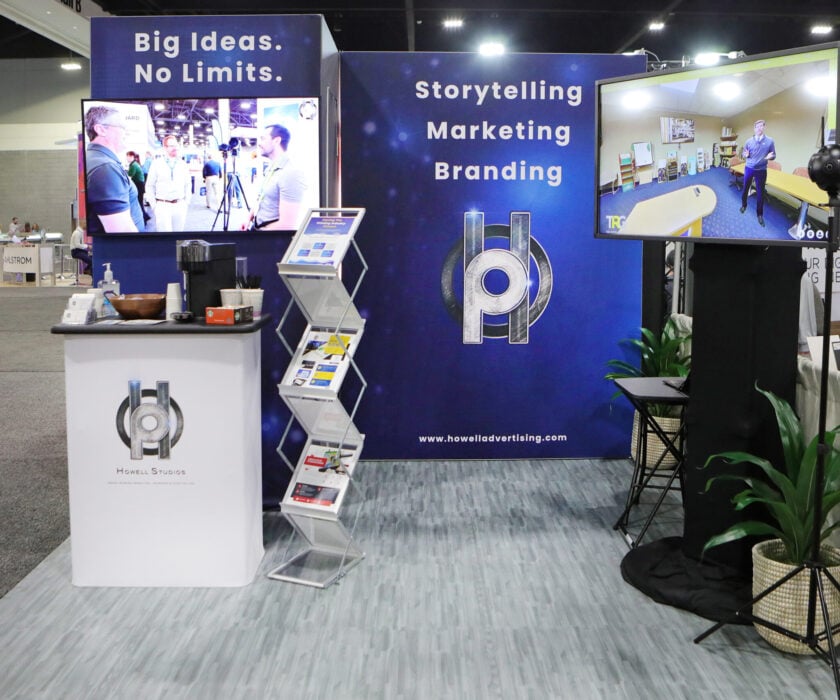
At Howell Studios, that system spans motion, static, and web, because a modern brand is rarely one flat logo. It shows up as a brand film, a set of social templates, a website, and printed collateral, and all of it has to feel like the same company. You can see the full scope of what a branding engagement includes on our branding services page.
Branding versus a logo: what you are actually paying for
A logo is a single asset. Branding is the strategy, identity system, and consistency that give the logo meaning. Confusing the two is the most common and most expensive mistake buyers make. Consistency is where the payoff lives: research from Marq (formerly Lucidpress) found that companies presenting a consistent brand can see revenue rise by as much as 33 percent, though it is worth reading that as an industry survey rather than a controlled study.
Think of the logo as the front door and the brand as the house. A memorable mark helps customers recognize you, but recognition without a clear promise, a consistent voice, and a reason to trust you does not move revenue. That is why a good agency spends real time on strategy before design. It is defining what the brand should make people feel and believe, so every asset that follows carries the same message.
Why brand trust is a revenue decision
Trust is not a feel-good metric, it is a purchase trigger. Edelman’s brand trust research found that 81 percent of consumers said trusting a brand is a deal breaker or deciding factor in whether they buy at all. Branding is how you earn that trust before a single sales conversation happens.
A strong brand signals reliability in seconds. Consistent visuals, a clear promise, and a professional presence tell a prospect you are established and safe to choose. When a competitor looks scrappy and inconsistent, the buyer quietly assumes the product is too. This is the real job of a branding agency: not to make you look pretty, but to make you look like the obvious, trustworthy choice in a crowded market.
The value of brand
What strong branding is worth
Measured performance gaps between design-led brands and the rest.
32%
faster revenue growth at design-led companies
56%
higher total shareholder returns over five years
81%
of consumers say brand trust decides a purchase
65%
forward P/E premium for strongly branded B2B firms
McKinsey, The Business Value of Design (five-year study); Edelman brand trust research; Brand Finance 2026 B2B brand premium.
Does branding still matter for B2B?
Yes, and the gap between strong and weak B2B brands is widening. McKinsey analysis published in Forbes found that strong B2B brands outperformed weak ones by 20 percent on operating margin in 2012, up from 13 percent the year before. That finding has only compounded. In 2026, Brand Finance reports that strongly branded B2B businesses command a 65 percent premium in forward price-to-earnings ratios, and the world’s 300 most valuable B2B brands now represent 4 trillion dollars in brand value, equal to 11 percent of enterprise value.
The old assumption that B2B buyers decide on specs and price alone does not hold. Buyers are people, they research quietly, and they shortlist the companies they already recognize and trust. A brand that is consistent, credible, and clear shortens that shortlist in your favor. For B2B teams, branding is not a vanity line item, it is pricing power and pipeline.
How your brand shows up online
Your website is where most people form their first real impression of your brand, and they judge it on looks faster than you would like. In the landmark Stanford Web Credibility study, 46.1 percent of people said a site’s visual design was a factor in how they judged its credibility, the single most-cited factor of all. Before anyone reads your value proposition, your design has already told them whether to take you seriously.
That is why branding and web design are hard to separate in practice. A brand system is only as strong as its most-visited surface, and for most companies that surface is the homepage. If you are weighing a website project alongside a rebrand, our guide to choosing a website design company walks through how the two fit together and where design quietly wins or loses conversions.
Branding for AI search and answer engines
Branding now shapes whether AI answer engines can recognize and recommend you at all. Tools like ChatGPT, Google’s AI Overviews, Perplexity, and Gemini increasingly sit between your customer and your website, and they answer questions by pulling from sources they can clearly identify and trust. A brand that presents one consistent name, description, and set of facts across the web is far easier for these systems to recognize as a distinct, credible entity.
This is newer ground, and it is where a modern branding engagement connects directly to search. Consistent naming, clear positioning language, structured information, and authoritative content all help answer engines understand who you are and cite you when a buyer asks. We treat this as part of the same discipline, which is why our SEO, AEO, and GEO services work from the same brand foundation. A confused brand is invisible to a machine reader, and in 2026 the machine reader often decides whether the human ever finds you.
Full-service versus specialist branding agencies
The right structure depends on how much of the rollout you want under one roof. A full-service agency handles strategy, identity, and every downstream asset, while a specialist studio may deliver a beautiful identity and then hand you a file to execute on your own. Neither is wrong, they solve different problems.
| Consideration | Full-service agency | Specialist branding studio |
|---|---|---|
| Best for | Companies that also need the website, video, photography, and marketing built on the new brand | Companies with an in-house team ready to execute a delivered identity |
| Scope | Strategy, identity, and rollout across web, video, print, and social | Strategy and identity system, sometimes guidelines only |
| Consistency | Higher, one team owns every touchpoint | Depends on your team’s discipline after handoff |
| Coordination | One partner, one timeline | You coordinate execution vendors |
| Typical fit | Growing businesses and rebrands that touch everything | Established brands needing a focused identity refresh |
If a rebrand will ripple into your website, sales videos, and ad creative, a full-service partner usually protects consistency and saves you from stitching five vendors together. If you only need the identity and your team can carry it, a focused studio can be the leaner choice. Our overview of what a creative agency actually delivers can help you decide how much you want handled in one place.
What does working with a branding agency cost?
Branding pricing depends on scope, not on a fixed menu, so the honest answer is that it ranges widely. A standalone logo and basic identity might run a few thousand dollars, a complete brand strategy and identity system for a growing business commonly falls in the five-figure range, and an enterprise rebrand that touches naming, research, and a full asset library can run well beyond that. What you are really buying is the depth of strategy and the number of touchpoints the new brand has to cover.
Agencies usually price one of three ways: a fixed project fee for a defined deliverable, a phased engagement that separates strategy from design and rollout, or a retainer when branding rolls into ongoing marketing. The most useful thing you can do is define the outcome you need before you compare quotes. A cheap logo that ignores strategy is not a bargain if it fails to earn trust, and an expensive engagement is not a waste if it lifts perception, pricing power, and conversion the way strong design demonstrably can.
How to choose the right branding agency
Choose the agency that interrogates your business before it shows you design, because strategy is what separates branding that performs from decoration that does not. The portfolio tells you whether they can execute. The questions they ask tell you whether they will solve the right problem. Here is what to evaluate:
- Do they lead with strategy? The best partners ask about your customers, competitors, and goals before mentioning colors. If the first conversation is about visuals, keep looking.
- Can they show results, not just pretty work? Ask for examples where branding moved a business metric, and ask what changed and why.
- Do they deliver usable guidelines? A brand you cannot apply consistently is a brand that decays the moment the agency leaves.
- Can they carry the rollout you need? If your rebrand will touch the website, video, and social, confirm they can execute it or coordinate it cleanly.
- Do they think about discovery? In 2026, ask how they will make sure your brand is recognizable to search and AI answer engines, not just to people.
- Does the relationship fit? Branding is collaborative and personal. You will share a lot about your business, so the partner has to feel like one.
A transparent, proven process is the clearest signal that an agency will deliver more than a nice presentation. Ask to see how they run an engagement from discovery to launch before you commit.
Frequently Asked Questions
How much does a branding agency cost?
It depends entirely on scope. A basic logo and identity can start in the low thousands, a full brand strategy and identity system for a growing business commonly lands in the five-figure range, and a large rebrand with naming and research runs higher. Define the outcome you need first, then compare quotes against that scope rather than against each other.
How long does a branding project take?
Most focused identity projects take four to eight weeks, while a full strategy plus identity and rollout often runs two to four months. Timelines depend on how much research the strategy requires, how many stakeholders approve the work, and how many touchpoints the new brand has to reach.
What is the difference between a branding agency and a freelance designer?
A freelance designer typically executes a specific deliverable, such as a logo, very well. A branding agency owns the strategy, the full identity system, the guidelines, and the rollout across every channel. If you need a single asset, a freelancer can be ideal. If you need a coherent brand that stays consistent as you grow, an agency is built for that.
Do I need a full rebrand or just a brand refresh?
A refresh updates the visuals while keeping your recognized equity, and it fits companies whose reputation is strong but whose look feels dated. A full rebrand rethinks strategy, positioning, and identity, and it fits companies that have outgrown their old brand, merged, or need to reset perception. When in doubt, a strategy conversation will surface which one the business actually needs.
Can a branding agency also build my website and run my marketing?
A full-service branding agency can, and there is a real advantage to it. When one team owns the brand, the website, the video, and the marketing, every touchpoint stays consistent, which is exactly what drives recognition and trust. Specialist studios usually stop at the identity and hand execution to your team or other vendors.
Ready to build a brand that earns attention and trust?
Big ideas deserve a brand that carries them. If you are weighing a new brand, a refresh, or a full rebrand that reaches your website, video, and marketing, the smartest first step is a strategy conversation, not a design request. We have helped companies tell their story since 2010, and we would like to hear yours. Book a strategy call with Howell Studios and let’s map what your brand could become.