VIDEOGRAPHY
Your work is already the most visible marketing you own. Every channel-letter set, monument sign, and wayfinding package you have installed is bolted to a building where thousands of people pass it every day. None of that shows up when a general contractor, an architect, or a facilities director is deciding who to trust with a six-figure signage package. They see a contact form, a phone number, and a photo gallery. Video is how you put your shop, your crew, and your finished work in front of the people who award the bigger jobs — before they ever call you.
This is written for the owner or marketing lead at a sign company, not for a marketer. It is about one thing: using video to move up from single-location work to the multi-site rollouts, campus wayfinding packages, and architectural signage jobs that carry real margin.
Why does video help a sign company win bigger projects?
A single storefront sign is often one owner’s decision. A twenty-location retail rollout or a corporate campus wayfinding package is not. It runs through a general contractor, an architect, a facilities manager, and a brand director — and every one of them is managing risk. They are not only asking whether your price is right. They are asking whether your shop can fabricate at that scale, whether your crew can hang it safely and on schedule, and whether the finish will match the renderings the architect signed off on.
Video answers those questions before the first meeting. Across B2B buying, 70% of buyers watch video during the purchase decision and 96% say video is important to whether they advance a supplier (Levitate Media, B2B Video Marketing Statistics, 2026). A page with video on it can convert up to 86% better than the same page without one (Firework, 2025). The bigger the project, the more the buyer is buying certainty — and certainty is exactly what a photo cannot carry and a video can.
On a large signage package, the buyer is not choosing a price. They are choosing the crew they trust to fabricate it right, hang it safely, and finish on schedule. Video is how they meet that crew early.
Why buyers of large signage packages watch first
Video is now part of the B2B buying decision
The people who award multi-site and architectural sign jobs research before they call.
70%
of B2B buyers watch video during the purchase decision
96%
say video matters to whether they advance a supplier
Up to 86%
higher conversion on a page that carries video
93%
of marketers report strong ROI from video in 2025
Sources: Levitate Media, B2B Video Marketing Statistics (2026); Firework (2025); Levitate Media, Video Conversion Statistics (2026).
What kinds of video actually move a sign deal?
Five do the work. You do not need all five to start.
- A capability reel. Sixty to ninety seconds through your shop: fabrication, large-format print, paint and metal, the install crew and their equipment. It answers the first question a large buyer has — can this shop handle our scale.
- A project case study. One named job: the problem, the build, the install, the finished result on the building. This is the strongest single asset for winning a bid, because it shows you have already done the thing they are about to ask for.
- An installation time-lapse. A monument sign set with a crane, or a channel-letter package hung across a facade, compressed to sixty seconds. It proves you can execute a complex install safely and on time — the thing a general contractor loses sleep over.
- A capability short. One thing you want to be known for — illuminated channel letters, monument and pylon signs, or environmental graphics — shown from raw material to finished install.
- A founder or relationship film. The trust piece for long-term accounts and corporate rebrands, where the buyer is choosing a partner for years, not one purchase order.
Which video should you make first?
Start with the decision you are trying to move. If you want onto a general contractor’s bid list, lead with a case study of a project like the ones you want to be invited to. If you want architects to specify your shop by name, make the capability reel that shows engineering, materials, and finish quality. Do not try to make one video carry every message — a reel that tries to be everything reads as an advert, and buyers skip adverts.
What should a sign-company capability video show?
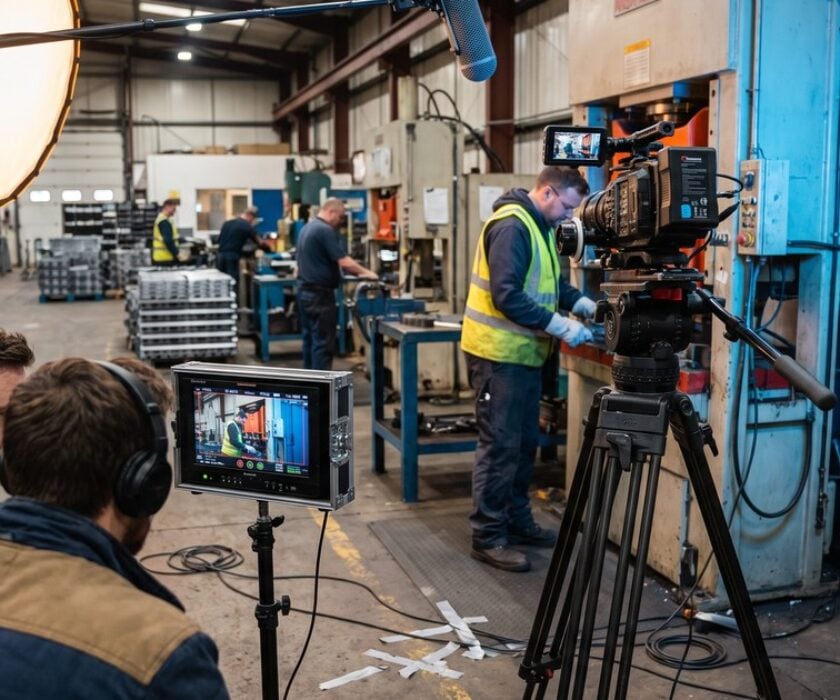
Show the craft first. Fabrication of channel letters, dimensional lettering, monument and pylon signs. Large-format print and finishing. The paint booth, the metal work, the welds. Then the part most sign companies leave out and large buyers care about most: the install crew, the lifts and cranes, the engineering and permitting, and how you keep a site safe. A buyer awarding a large package is hiring a team, not a machine — so put the people on camera. Show enough range that a facilities director watching can see their own project in it.
How do you use these videos to win the bid?
The video only works where the buyer already is:
- On the project page your proposal links to, so the buyer watches before the meeting.
- Embedded directly in the proposal or RFP response.
- In the email to the architect or general contractor a day before you present.
- In sales follow-up after a site walkthrough, while the job is still warm.
- On the capabilities page of your own site — so when a facilities director searches for a shop that can fabricate and install what they need, your work is what they find.
That last point is doing double duty now. When someone asks an AI assistant “who can fabricate and install large-scale signage,” the answer is built from pages that clearly show the capability. Video plus plain, specific text about what you make is how a sign company becomes the answer instead of a link nobody clicks.
What does a video like this cost, and what should you ask for?
Cost depends on scope — how many sites you film, whether there is travel, and how many finished cuts you need — so anyone quoting a flat number before seeing the work is guessing. The economics that matter are these: one well-run production day, filmed and organized properly, becomes a capability reel, three or four project cuts, and a library of short clips for proposals, sales, and social. Ask for the raw selects and multiple aspect ratios up front, so one shoot feeds a full year of bids instead of a single video. For a scoped figure on your own project, tell us what you are bidding on.
How do you know the video worked?
Not by view count. Track the things that mean money: your invite-to-bid rate with the buyers you sent it to, your win rate on bids where the video was used, your average project value, and whether larger buyers — general contractors, architects, developers — are the ones now reaching out. Watch-through is a secondary signal. The real measure is bigger jobs entering your pipeline than were entering it before.
Frequently asked questions
Do sign companies really need video, or is a photo gallery enough?
Photos prove the finished product. Video proves the process, the crew, and the ability to execute at scale — which is what a buyer awarding a large package is actually evaluating. For single-location work a gallery may be enough; for bigger projects it is not.
What is the single most useful video for winning bids?
A project case study of a job like the ones you want to win. It shows a specific buyer that you have already delivered their situation.
How long should a sign-company capability video be?
Short. B2B buyers prefer short formats that show the benefit fast — 74% favor concise video over longer detail (Levitate Media, 2026). Keep a capability reel to 60–90 seconds; a case study can run two to three minutes.
Can one shoot produce more than one video?
Yes. A well-run production day yields a capability reel, several project cuts, and short clips for proposals, sales, and social — if you ask for the raw footage and multiple aspect ratios at the start.
Where do these videos actually get used?
Proposals and RFP responses, the project pages of your website, pre-meeting emails to architects and general contractors, and sales follow-up after a walkthrough.
Put your best work in front of the people who award the big jobs
We make product and capability video and brand films for the companies that build the physical world — and we plan them around the decision you are trying to win, not around a camera. For the wider print and large-format trade behind the signs, see video production for the printing industry. If you also run manufacturing work, the same approach applies to planning a manufacturing video — and, for shops in Florida, how Florida manufacturers use video to win new business. When you are ready, tell us what you are bidding on and we will show you the shortest path to a video that helps you win it.
Plan the video around the bid you want to win
We plan and produce product and capability video for sign companies — built around the buyer decision it has to move, and filmed around your shop, your crew, and your install.