MARKETING
Most business owners think their marketing falls flat because they are not posting enough, or not spending enough. Usually that is not the problem. The problem is that they are telling the wrong story, or no story at all.
Short answer: there are seven types of brand stories, and the right one depends on what you are trying to accomplish. Launching something new calls for a different story than overcoming a customer objection. This guide walks through all seven, what each one is best for, and how to choose the one that actually moves revenue. The framework of seven story types was popularized by Muse Storytelling, and below is how we apply it at Howell Studios for the owners we work with.
Key Takeaways
- There are seven brand story types: Origin, Values, Why, Vision, Teaching, Impact, and Objection. Each one does a specific job.
- Start with your objective, then pick the story built for it. To drive sales, use an Impact or Teaching story. To launch, use an Origin or Why story. To overcome a hesitation, use an Objection story.
- Story changes what people will pay. In one experiment, thrift-store items resold for roughly 28 times their cost once a story was attached (Significant Objects).
- The right story usually beats the bigger budget. Two shops can do identical work, and the one with the better story wins the better clients at the better price.
- If you cannot tell the ideal story yet, one real customer story can carry the load, or pick another type that hits the same objective and come back later.
Why the type of story matters more than the budget
The type of story you tell matters more than what you spend, because story is what makes your work feel more valuable than the competitor’s. Here is the trap most owners fall into. You do great work, so you assume the work will speak for itself and the right customers will find you. They rarely do.
Your product or your service is not automatically more valuable than your competitor’s. What makes it feel more valuable is everything you wrap around it: the story you tell, the language you use, and the way you show up. Two shops can do identical work, and the one with the better story wins the better clients at the better price.
The research backs this up. Stanford professor Jennifer Aaker is widely cited for the finding that stories are up to 22 times more memorable than facts alone. And in a project called Significant Objects, writers Rob Walker and Joshua Glenn attached short written stories to cheap thrift-store trinkets, then resold them on eBay. Objects that cost a total of $128.74 sold for $3,612.51, roughly 28 times what the researchers paid, purely because of the story attached (Significant Objects). Same object. Different story. Wildly different value.
That is the whole game. You are not just selling the thing you make. You are selling the story around it.
The 7 types of brand stories
There are seven story types that cover almost every marketing goal a business has. Each one does a specific job. Learn what each is for, and choosing gets simple. Here is the full set mapped to the stage of the buyer’s journey where it works hardest.
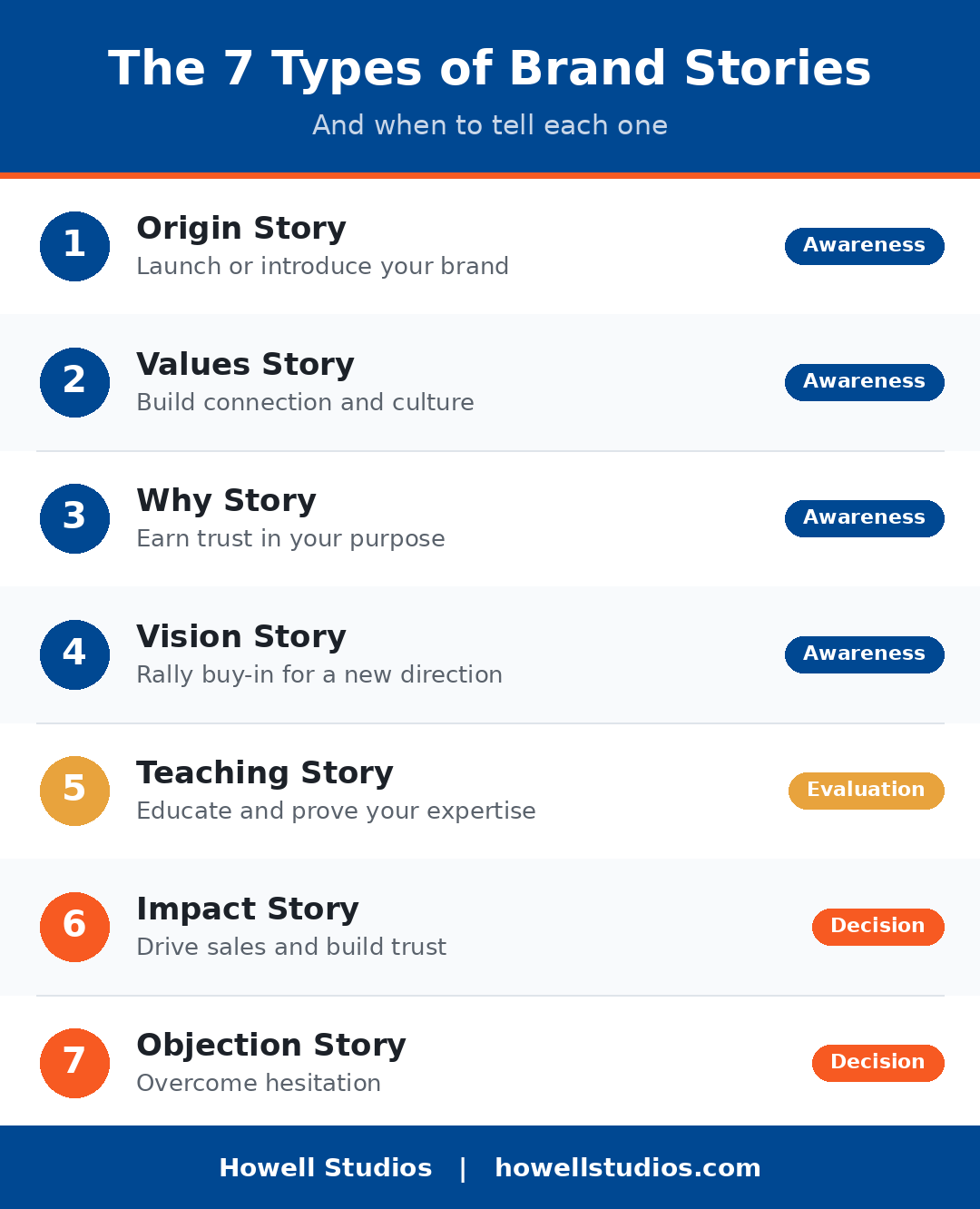
For examples of each of these drawn from our own client work, see the 7 types of stories we tell at Howell Studios.
1. The Origin Story
What it is: the story of how your business came to be. Where the idea started, what need you saw, and why you decided to build something to solve it.
Best for: launching a product, service, or brand, or introducing yourself to a new market.
Why it works: it answers the question every prospect is quietly asking, which is “why you.” Competitors can copy your services and undercut your price, but nobody can copy your origin. It is the one thing that is entirely yours.
Owner example: a sign shop founder who spent years waiting on slow, sloppy vendors, got fed up, and started a shop built around fast turnaround and doing it right the first time. That origin instantly tells a prospect what the shop stands for.
Where to use it: your homepage, your About page, the opening of a pitch, and product launches.
2. The Values Story
What it is: a story that shows why your business holds a specific value or standard, and how that value shows up in the work.
Best for: building awareness and connecting people to your brand.
Why it works: people do business with companies that share their values. A values story associates your brand with something a customer already cares about, which builds a bond that price alone cannot break.
Owner example: a commercial printer whose entire operation is built around never missing a deadline, told through the night the whole crew stayed late to save a customer’s product launch. That is a value made visible, not just claimed.
Where to use it: your Meet the Team page, recruiting materials, blog posts, and short social videos.
3. The Why Story
What it is: the story of why you do what you do, or why you care about a certain project, customer, or mission. It is the motivation behind the work.
Best for: building awareness, connecting customers to your brand, and launching something new.
Why it works: it connects people to your larger purpose and builds trust in your intentions. When people understand why you do the work, they trust how you do it.
Owner example: a manufacturer who builds specialty equipment because a preventable failure early in their career put people at risk, and they decided to build the thing that would never fail that way again. That why reframes the whole company.
Where to use it: your homepage, your About page, proposals, and the start of talks and pitches.
4. The Vision Story
What it is: a story that makes where you are headed tangible enough that others can see it and want to come along. The origin story shows where you came from. The vision story shows where you are going.
Best for: building awareness and rallying support for a new direction.
Why it works: it turns an abstract future into something a customer, an investor, or a new hire can picture and buy into.
Owner example: a wide-format shop investing in automation and AI-driven lead systems, painting a clear picture of a print business that quotes in minutes and never lets a lead go cold. That vision attracts both customers and talent who want to be part of it.
Where to use it: internal team alignment, investor conversations, and public announcements of a new direction.
5. The Teaching Story
What it is: a story used to teach a lesson or a skill. Wrapping the lesson in a story makes it far more engaging and far more memorable, so the audience actually retains it.
Best for: educating your customers and positioning yourself as the expert, which drives sales.
Why it works: giving away real knowledge for free builds authority and trust. The article you are reading right now is a teaching story. It gives away useful information, and in doing so it shows you how we think about storytelling in marketing.
Owner example: a print shop publishing a short guide on how to prep files so a job does not get delayed at production. It helps the customer and quietly proves the shop knows its craft.
Where to use it: how-to guides, tutorial and explainer videos, blog posts, and lead magnets that capture email addresses.
6. The Impact Story
What it is: the story of the difference your business made for a real customer. It is more than a case study or a testimonial. A strong impact story has a real character and a real journey, not just a result.
Best for: driving sales and closing the deal.
Why it works: it shows the return on working with you, and prospects trust the experience of someone like them more than any claim you make about yourself. Buyers actively look for this kind of proof right before they decide.
Owner example: the story of one customer who was drowning in missed leads, switched to your shop and your follow-up system, and booked more work in a quarter than the previous year. Told as that owner’s journey, it becomes something a similar owner sees themselves in.
This is the kind of story we build every day. Our brand film for LMC Industrial Contractors turns a day of hard industrial fieldwork into a story about craft, safety, and the people behind the welds, so a prospect feels the company’s standard before a single sales call. You can see more of these on our case studies page.

Where to use it: your website and testimonials, social channels, proposals, and anywhere you are asking for the sale.
7. The Objection Story
What it is: a story that first validates a common objection, then reframes it. It follows someone who had the same hesitation, the journey they went on, and the new way of thinking they landed on.
Best for: overcoming a known objection or hesitation.
Why it works: it disarms the objection without arguing. Instead of telling a prospect they are wrong, you show them someone who felt the same way and changed their mind.
Owner example: the shop owner who was sure video and paid marketing were too expensive and that word of mouth was enough, until word of mouth dried up and a competitor pulled ahead. Their turnaround story handles the objection before your prospect even voices it.
Where to use it: sales conversations, sales pages, and paid ads aimed at a skeptical audience.
The 7 story types at a glance
Use this table as a quick reference when you are deciding which story to tell.
| Story type | Best for | Where it shines | Funnel stage |
|---|---|---|---|
| Origin | Launching, introducing your brand | Homepage, About, pitches | Awareness |
| Values | Awareness, connection, culture | Team page, recruiting, social | Awareness |
| Why | Awareness, connection, launches | Homepage, About, proposals | Awareness |
| Vision | Buy-in for a new direction | Internal alignment, announcements | Awareness |
| Teaching | Educating, proving expertise | Guides, how-to video, blogs | Evaluation |
| Impact | Driving sales, building trust | Testimonials, case studies, proposals | Decision |
| Objection | Overcoming hesitation | Sales calls, sales pages, ads | Decision |
How to choose the right story
Start with your objective, then match it to the story that delivers on it. Here is the simple mapping we use:
- Drive sales: Impact Story or Teaching Story.
- Launch a product, service, or brand: Origin Story or Why Story.
- Build awareness or connection: Vision, Why, or Values Story.
- Educate your customers: Teaching Story.
- Overcome a hesitation: Objection Story.
Two more lenses help when more than one story could work.
Emotion versus information. If the goal is to make people feel something and connect, lean toward a Vision, Why, or Values story. If the goal is to convey specific information or handle a concern, lean toward a Teaching or Objection story.
Where the buyer is in the funnel. Early on, when people barely know you, Origin, Why, Vision, and Values stories have the broadest appeal. In the middle, when they are evaluating you, a Teaching story gives them the specifics they want and proves you know your craft. At the end, when they are ready to act, a focused Impact or Objection story pushes them over the line.
What if you cannot tell the ideal story yet
Sometimes the best-fit story is not available. A newer business often cannot tell a strong impact story, because the impact has not happened at scale yet.
That does not make it impossible. If even one customer has a real story of the difference you made, that single story can carry the load. We have built powerful impact stories around a client’s very first customer. If you truly do not have one yet, pick another story type that hits the same objective, and come back to the impact story once you have earned it.
Also expect some overlap. An origin story often carries a why story inside it, since how you started usually reveals why you started. That blend is fine. The point is not to force a story into one clean box. The point is to match your objective to the one or two story types that serve it best.
The bottom line
Great work is not enough on its own. The businesses that win are the ones that communicate their value clearly, and story is how you do that. Pick your objective, choose the story type that delivers on it, and tell it well. That is the difference between getting scrolled past and getting remembered, and between competing on price and being chosen on value.
At Howell Studios, choosing and building these stories is the core of what we do. We help owners find the right story and bring it to life through video production, brand films, and story-driven marketing that turns attention into real revenue. If you want help figuring out which story your business should be telling, book a free strategy call.
Frequently Asked Questions
What are the 7 types of brand stories?
The seven types are the Origin Story, Values Story, Why Story, Vision Story, Teaching Story, Impact Story, and Objection Story. Each serves a different marketing objective, from launching a brand to closing a sale.
Which story type is best for driving sales?
The Impact Story is usually strongest for driving sales, because it shows a real customer’s result and helps a prospect picture the same outcome for themselves. Teaching Stories also drive sales by building trust and positioning you as the expert.
How do I choose which story to tell?
Start with your objective. Match it to the story type built for that goal, then consider whether you need emotional connection or information, and where your buyer sits in the funnel. If two stories fit, test both.
Does storytelling actually increase sales?
Research suggests it does. Stories are far more memorable than facts, and studies have shown that attaching a story to a product can dramatically raise what people are willing to pay for it. Story does not replace a good offer, but it makes a good offer far more compelling.
Can a business use more than one story type?
Yes. Most businesses use several across their website, sales process, and social channels, and story types often overlap. The goal is to match each piece of content to the objective it needs to serve.
About the author: This guide was written by the Howell Studios team. Howell Studios is a full-service creative marketing agency founded in 2010 as an award-winning video production company and grown into a video, brand film, web, and story-driven marketing studio. We help business owners find and tell the right story from our Orlando, FL studio at 7380 W Sand Lake Rd, Suite 500, with a second team in Rochester, NY. Call (407) 530-3989 or email discovery@howellstudios.com to talk through your project.