MARKETING
AI CRM: What It Does and the Real Revenue Impact

Your CRM already holds a goldmine: every lead, conversation, and deal. The problem is that most of it just sits there. An AI CRM changes that, using artificial intelligence to score leads, forecast deals, draft follow-ups, and tell your team who to call next. It’s not a fringe idea anymore: Howell Studios builds AI into how our clients sell, and 70% of companies already use AI in their CRM. Here’s what that means and whether it’s worth it.
Key Takeaways
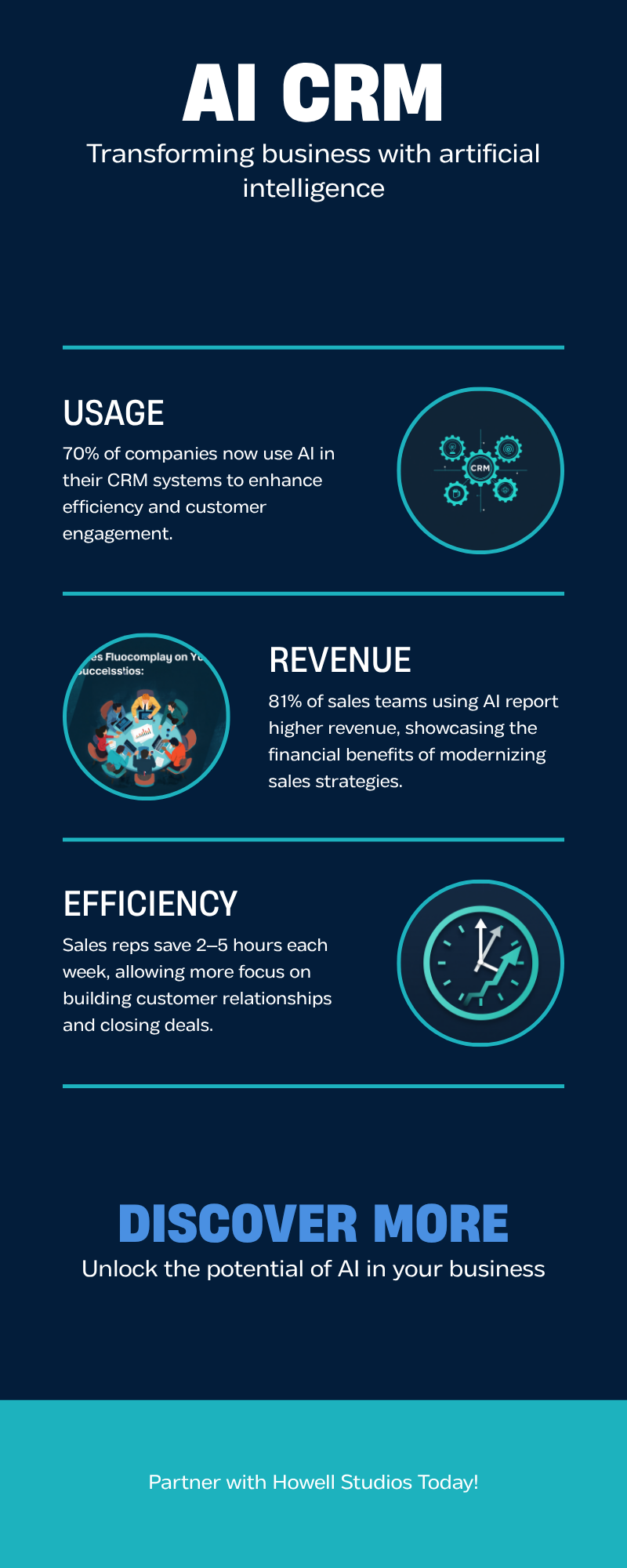
- 70% of companies now use AI in their CRM for tasks like forecasting, lead scoring, and outreach (Teamgate, 2025).
- 81% of AI-using sales teams report higher revenue (Teamgate, 2025).
- AI automation saves sales reps roughly 2–5 hours a week on manual CRM work (Teamgate, 2025).
- The payoff comes from using AI to act on your data, not just store it, with a human owning the relationship.
What Is an AI CRM?
An AI CRM is a customer relationship management system with artificial intelligence built in, so it doesn’t just record your customer data, it analyzes it and acts on it. Rather than a passive database, it predicts, prioritizes, and automates. Adoption is already mainstream: 70% of companies use AI in their CRM, and many use generative AI specifically for forecasting, lead scoring, and personalized outreach (Teamgate, 2025).
The shift is from “system of record” to “system of action.” A traditional CRM tells you what happened. An AI CRM tells you what to do next, and often does part of it for you.
What Can an AI CRM Actually Do?
It removes busywork and surfaces the deals most likely to close. The highest-value capabilities for most teams:
- Lead scoring — ranking prospects by likelihood to buy, so reps work the best ones first.
- Sales forecasting — predicting which deals will close and when.
- Automated data entry — logging calls, emails, and notes without manual input.
- Follow-up drafting — generating personalized emails and next steps.
- Next-best-action — recommending the right move for each contact.
Together these feed the same engines that power AI-powered marketing automation and AI lead generation.
AI CRM vs. a Traditional CRM
A traditional CRM records what happened; an AI CRM acts on it. The gap shows up in everyday work:
| Capability | Traditional CRM | AI CRM |
|---|---|---|
| Customer data | Stores records | Analyzes and predicts |
| Leads | Worked in list order | Scored by likelihood to buy |
| Follow-up | Manual, easy to miss | Drafted and automated |
| Forecasting | Gut feel and spreadsheets | Data-driven predictions |
| Rep’s time | Spent on data entry | Spent selling |
What we see in client work: the teams that win with an AI CRM start with one workflow, usually follow-up or lead scoring, prove it, then expand. The ones that try to automate everything at once tend to abandon it. Start narrow, then widen.
Why Does an AI CRM Matter? The ROI
Because it directly moves revenue and frees up selling time. 81% of sales teams using AI report higher revenue, and reps save about 2–5 hours a week when AI handles manual CRM tasks (Teamgate, 2025). Those reclaimed hours go back into actual selling instead of data entry. The platform itself pays off too: CRM systems return an average of $8.71 for every $1 spent (CRM.org, 2025).
The compounding effect matters most. Better lead scoring means reps spend time on deals that close; automated logging means cleaner data; cleaner data means better forecasts. Each improvement makes the next one stronger.
AI CRM for Small and Mid-Sized Businesses
You don’t need an enterprise budget to benefit. Modern AI features are built into CRMs at every tier, so a small team can get enterprise-grade lead scoring and automated follow-up without a big sales operations department. The key is to pick the workflow closest to revenue, prove it, then add more.
For a small business, the win is leverage: AI lets a lean team behave like a much larger one, never dropping a lead and always following up on time. That’s the same principle behind hiring an AI digital marketing agency.
Don’t Let the AI Run the Relationship
The mistake is treating AI predictions as decisions. AI is excellent at scoring, drafting, and prioritizing, but it doesn’t close deals or build trust, people do. The strongest setups use AI to tee up the work and keep a human accountable for the conversation, the judgment, and the relationship.
Keep your team reviewing AI’s lead scores and editing its drafts. Used that way, an AI CRM makes good salespeople faster, not replaceable. See how we balance the two in our process.
Frequently Asked Questions
What is an AI CRM?
It’s a CRM with artificial intelligence built in that analyzes and acts on your customer data, scoring leads, forecasting deals, automating data entry, and drafting follow-ups, rather than just storing records. About 70% of companies already use AI in their CRM (Teamgate, 2025).
Does an AI CRM actually increase revenue?
For most teams, yes. 81% of sales teams using AI report higher revenue, partly because reps save 2–5 hours a week on manual tasks and spend more time selling (Teamgate, 2025). The gains come from acting on data, not just collecting it.
Is an AI CRM worth it for a small business?
Yes. AI features are now built into CRMs at every price tier, so a small team gets enterprise-grade lead scoring and follow-up automation without a sales-ops department. Start with one workflow and expand.
Will an AI CRM replace salespeople?
No. AI handles scoring, drafting, and prioritization; people handle judgment, trust, and closing. The best results pair AI’s speed with a human who owns the relationship.
How do I choose an AI CRM?
Pick based on the workflows closest to revenue, lead scoring, follow-up, and forecasting, and confirm the AI features are usable by your team, not just marketing claims. Tie the decision to measurable outcomes like win rate and time saved.
The Bottom Line
An AI CRM turns the customer data you already have into action, scoring leads, forecasting deals, and automating the busywork that slows your team down. With 70% of companies on board and most reporting higher revenue, the question is how well you apply it, with people still owning the relationship.
- What it is: a CRM that analyzes and acts, not just stores.
- What it does: lead scoring, forecasting, automated follow-up.
- Why it matters: higher revenue, 2–5 hours/week saved per rep.
- The rule: AI for speed, humans for the relationship.
Want a CRM and marketing system that actually uses your data? Talk to the Howell Studios team. Call (585) 558-3321 or email info@howellstudios.com.
Sources
- Teamgate, “State of CRM in 2025 (Trends, AI adoption, ROI stats)” (70% of companies use AI in their CRM; 81% of AI-using sales teams report higher revenue; reps save 2–5 hours/week), retrieved 2026-06-18, https://www.teamgate.com/blog/state-of-crm-2025-trends-ai-adoption-roi-stats/
- CRM.org, “45 CRM Statistics You Need to Know in 2025” (CRM ROI and adoption context), retrieved 2026-06-18, https://crm.org/crmland/crm-statistics