MARKETING
AI Marketing for Printing Companies: A Practical Guide
Most print shops still win work the way they always have: referrals, repeat clients, and a good showing at the trade show. That still matters, but it’s no longer enough, because buyers now find and vet vendors online long before they call. That online-first shift is what we mean by digital transformation in print. The good news for printing companies: AI marketing lets a lean shop compete for that online attention without hiring a big team. Howell Studios markets printing and signage companies for a living, and here’s the practical version of how AI fits in.
Key Takeaways
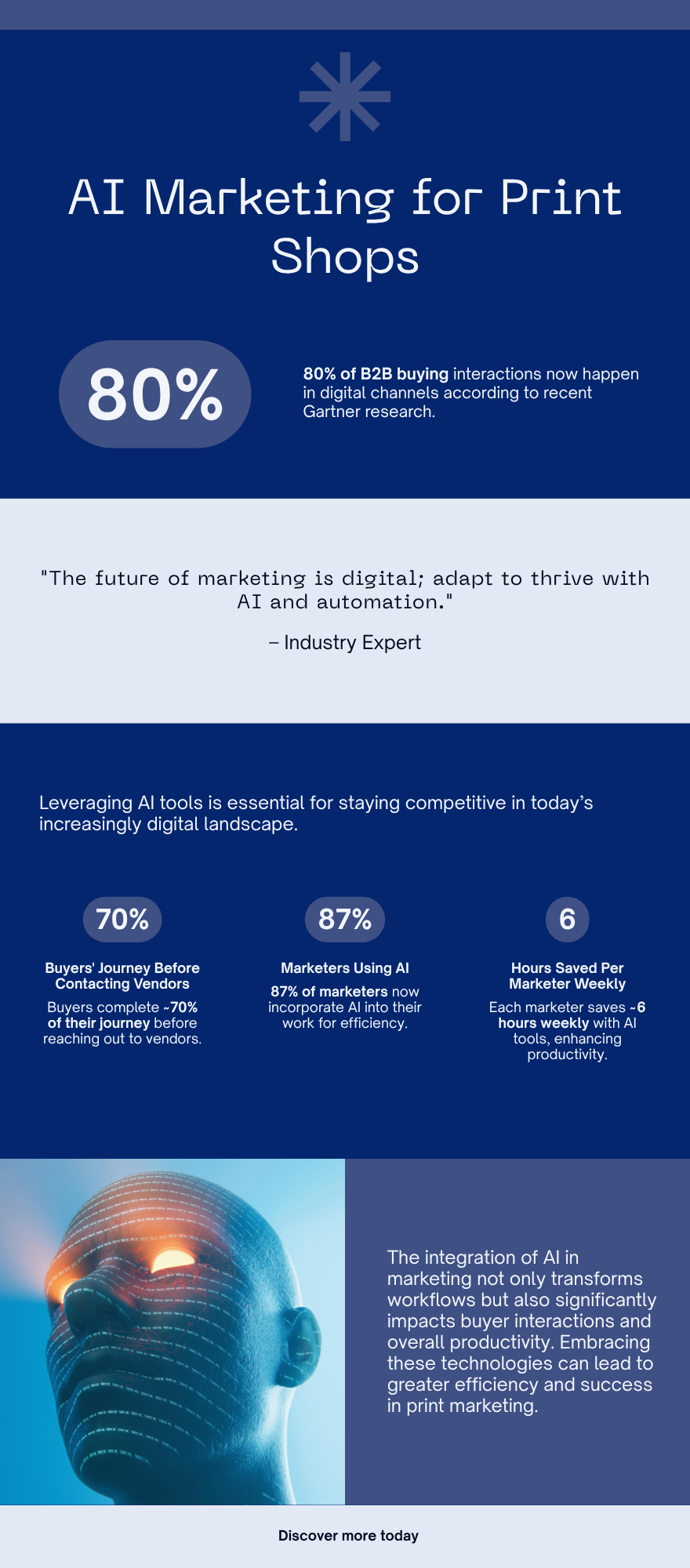
- 80% of B2B buying interactions now happen in digital channels, and buyers complete about 70% of their journey before contacting a vendor (Gartner, 2025).
- 87% of marketers now use AI, saving roughly 6 hours a week (CoSchedule, 2025).
- AI lets a small print shop produce SEO, content, and social at a scale that used to require a marketing department.
- The win isn’t replacing your team with a bot, it’s using AI for speed and keeping a human on strategy and brand.
Why Word-of-Mouth Alone No Longer Fills the Pipeline
Because your buyers go digital first. Today 80% of B2B buying interactions happen in digital channels, and most buyers finish roughly 70% of their decision journey before they ever contact a vendor (Gartner, 2025). If a prospect can’t find your print shop, see your work, and trust you online, you’re often eliminated before the conversation starts.
That doesn’t make referrals or trade shows obsolete, it makes your digital presence the thing that converts them. The reference, the booth, the postcard, they all send people to search you. What they find decides whether you make the shortlist.
How Does AI Help a Print Shop Market Itself?
It removes the two biggest barriers small shops face: not enough time, and not enough marketing staff. AI now handles the heavy lifting across channels, and 87% of marketers already use it, saving about 6 hours a week (CoSchedule, 2025). For a print business, that shows up as:
- Local SEO — getting found for “print shop near me” and your specific services.
- Content — turning your expertise (materials, finishes, turnaround) into pages and posts that rank.
- Social media — consistent, on-brand posts without a full-time social manager.
- Email & follow-up — nurturing quote requests and past clients automatically.
- Lead capture — chat and forms that answer common questions and book estimates.
We break down the lead-gen side further in our guide to AI marketing strategies for printing. Sign shops can go deeper in our playbook on sign company lead generation.
AI Marketing Use Cases for Printing Companies
The best use cases turn what your shop already knows into marketing that runs itself. You have deep expertise, AI helps you publish it consistently. A few that work well for printers:
- Service pages that rank — a clear, optimized page for each capability (large format, signage, direct mail, packaging).
- “How-to” and spec content — answering the questions buyers search (“what file format for print,” “best material for outdoor signs”).
- Case studies at scale — turning finished jobs into proof, fast.
- Social proof and reels — repurposing shop photos and videos into steady social content.
- Automated estimate follow-up — so no quote request goes cold.
For more on the fundamentals, see our 6 marketing strategies for printing companies.
How to Get Started With AI Marketing
Start small, with the channel closest to revenue. You don’t need to overhaul everything at once. A sensible order for most print shops:
- Fix the foundation — make sure your site is fast, mobile-friendly, and clear on what you print and where.
- Win local search — optimize your Google Business Profile and core service pages first.
- Publish consistently — use AI to keep content and social moving without burning your team out.
- Automate follow-up — capture and nurture every quote request.
- Measure what matters — track leads and jobs won, not likes. See our process.
Step one has a larger version for shops that live on repeat orders. A web-to-print storefront lets a customer reorder from their own catalog instead of emailing a purchase order, and the build-or-rent decision comes before any of it gets designed.
Don’t Hand It All to the Robot
The shops that get this wrong let AI run unsupervised and end up with generic, off-brand content. AI is powerful for speed and scale, but it doesn’t know your shop’s voice, your quality standards, or your customers the way you do. The winning setup pairs AI’s output with human review, the same balance we cover in our overview of an AI digital marketing agency.
Keep a person accountable for strategy, fact-checking, and brand, and let AI handle the repetitive production. That’s how a small print business markets like a much bigger one.
Frequently Asked Questions
Why do printing companies need digital marketing if they get referrals?
Because referrals still check you out online first. With 80% of B2B buying interactions now digital and buyers ~70% through their journey before contacting a vendor (Gartner, 2025), a weak online presence can cost you referred leads, not just cold ones.
How does AI marketing actually help a small print shop?
It does the work a small shop has no time for: local SEO, content, social posts, and lead follow-up. With AI, marketers save about 6 hours a week (CoSchedule, 2025), which lets a lean team market consistently instead of in bursts.
Will AI-generated marketing sound generic or off-brand?
It can, if you let it run unsupervised. The fix is human oversight: a person sets the voice, edits the output, and checks facts before anything ships. AI handles speed; people protect the brand.
What should a printing company invest in first?
Start with the foundation and local search: a clear, fast website and an optimized Google Business Profile, then consistent content and automated quote follow-up. Tie everything to leads and jobs won, not vanity metrics.
Can one agency handle marketing for a printing business?
Yes, and a specialist helps. An agency that knows the print industry can speak to your buyers, turn your capabilities into content, and apply AI with the right human oversight, see our case studies.
The Bottom Line
Your buyers already research online before they call, so the print shops that win the next decade are the ones that show up and convert there. AI marketing makes that reachable for a lean team, as long as a human stays on strategy and brand.
- Buyers go digital first: 80% of B2B interactions, ~70% of the journey before contact.
- AI closes the gap: SEO, content, social, and follow-up at scale.
- Start small: foundation and local search, then content and automation.
- Stay human: AI for speed, people for strategy and quality.
Run a printing or signage company and want marketing that brings in jobs? Talk to the Howell Studios team — we market printers for a living. Call (585) 558-3321 or email info@howellstudios.com.
Sources
- Gartner, “Gartner Sales Survey Finds 61% of B2B Buyers Prefer a Rep-Free Buying Experience” / Future of Sales (80% of B2B sales interactions occur in digital channels; buyers complete most of the journey before contacting a vendor), retrieved 2026-06-18, https://www.gartner.com/en/newsroom/press-releases/2025-06-25-gartner-sales-survey-finds-61-percent-of-b2b-buyers-prefer-a-rep-free-buying-experience
- CoSchedule, “State of AI in Marketing Report 2025” (≈87% of marketers use AI; ~6 hours/week saved), retrieved 2026-06-18, https://coschedule.com/ai-marketing-statistics
- Grand View Research, “Commercial Printing Market Size, Share | Industry Report, 2033” (market context: ~USD 510bn in 2025, ~3.8% CAGR), retrieved 2026-06-18, https://www.grandviewresearch.com/industry-analysis/commercial-printing-market